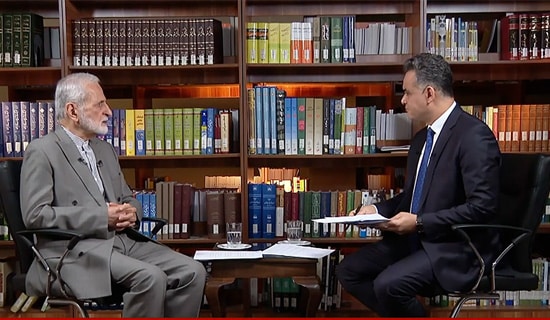
Several days before Israel launched its Gaza offensive, the deputy head of the Damascus-based political wing of Hamas, Moussa Abu Marzouq, told the Hamas magazine Al-Risala[1] in an interview that the Tahdiah, or calm, is a strategic goal for Israel but not for Hamas, and that therefore it must not be allowed to continue.
Following are excerpts from the interview:
The Tahdiah is the Exception, Resistance Is the Rule
Al-Risala: "Until the very last moment, Hamas had been reluctant to state a clear-cut position on extending the Tahdiah [calm]. Have any contacts been undertaken in an attempt to extend the Tahdiah under specified conditions?"
Abu Marzouq: "[Your] question implies that the Tahdiah is a central issue behind [our] decisions, consultations, and mediation attempts. However, the opposite is true… [for us,] resistance is the main [element] in the relations between the Palestinian people and the Zionist occupation. The Tahdiah, [which is an exception, emanated from] Egypt's [attempt] to bring about understanding between the Palestinian factions and Israel, so as to institute a six-month Tahdiah, which would spread also to the West Bank and would involve consultations and meetings on the issue of the Rafah crossing… Thus, for example, [it included] a 30% opening of the Rafah crossing for 10 days, following which the crossing would be fully opened.
SUPPORT OUR WORK

"However, this anomalous situation did not benefit the Palestinians in the least. Only 15% of the usual volume of essential goods entered Gaza via these crossings. The siege continued unchanged, and the Israeli aggression did not abate during the Tahdiah either. It would be unreasonable to view this anomalous situation either as a central issue or as a natural state of affairs. The [Tahdiah] had become 'a ceasefire [in exchange for another] ceasefire,' with no connection either to the crossings and [the goods] transported through them, or to the siege. Terminating it was [thus] a logical move.
"Before [December] 19 [i.e. the date the Tahdiah expired], Hamas's position on the issue was not explicit. It was Egypt that announced that the Tahdiah had come into effect, and Egypt set the timetable for it, and Egypt achieved understandings with all the Palestinian factions. Terminating the Tahdiah required a national consensus – and this is exactly how it came about. Understandings were achieved among the factions, [all of] which ultimately agreed that the Tahdiah was not benefiting the Palestinian people – and that is why it ended."
The Tahdiah is a Strategic Goal for Israel – Which Seeks Peace and Quiet in Gaza
Al-Risala: "A few days before the Tahdiah ended, a senior Israeli official visiting Cairo said that Israel would like to extend it. Did Egypt convey to you Israel's wish to extend the Tahdiah?"
Abu Marzouq: "It was not only via the Egyptian mediator that Israel expressed this [wish], but also – and very clearly – via the media, stating that a Tahdiah was its strategic goal. This is because [the Israelis] want peace and quiet in Gaza, in order to continue their sanctions in the West Bank and to make this situation ordinary.
"This is why Israel strove to extend the Tahdiah, and even asked for Egypt's [cooperation] in this matter, according to Egyptian [sources] and news agencies' reports. [However,] Egypt made no attempt to extend or revise [the conditions of] the Tahdiah, and the Palestinians showed no interest in agreeing to the Zionists' wish for it."
Endnote:
[1] Al-Risala (Gaza), December 12, 2008.